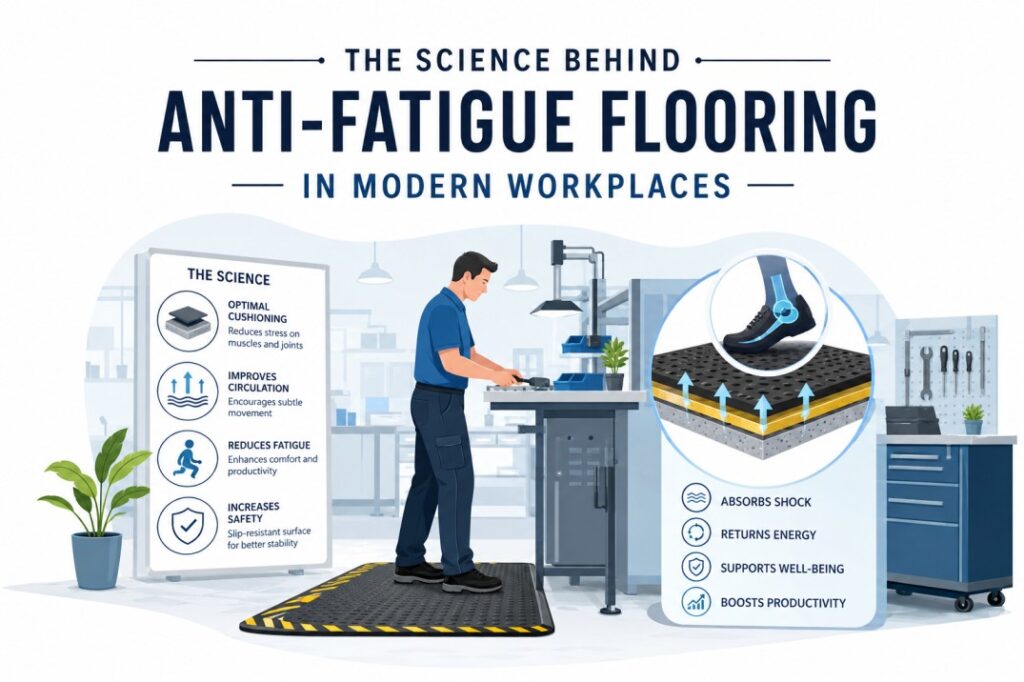
In some workplaces, workers need to stand for prolonged sessions to fulfil their job requirements. These workers include employees usually working at a factory’s production line with repetitive tasks on the same workstation, cashiers at retail stations, service counter representatives, or healthcare staff in operating rooms with prolonged and physically tiring shifts.
In such roles, the worker needs to maintain an upright position to work on a specific task or machine. They have limited space or opportunity to change their standing or working position. Workers who spend much of their shifts standing on hard floors experience discomfort in their feet, legs, and lower back.
In such a situation at the workplace, anti-fatigue mats or flooring can play a crucial role. Anti-fatigue mats are specially designed floor pads. These mats are required to provide the essential cushioning to those workers who need to stand or stay in the same position for prolonged periods. The purpose of these mats is to help reduce discomfort associated with prolonged standing on hard surfaces or floors.
Reasons for Fatigue during Prolonged Standing Shifts
The human body experiences tiredness and exhaustion when its physical activity is restricted. Standing or staying in the same position for many hours results in less muscle mobility. Humans can experience cramps in the muscles that maintain the same posture and barely move.
Standing for prolonged periods on hard flooring results in lower blood circulation, which triggers muscle rigidity and cramping. The main reason for this is having limited opportunity and mobility to shift natural weight from one body part to another. This specifically causes discomfort in shoulders, back, lower back, legs, and feet. If actions are not taken over time, these conditions can lead to chronic health issues like joint pain and varicose vein damage.
How Does an Anti-Fatigue Mat Work?
Anti-fatigue mats are made from materials that provide a certain level of cushioning for shock absorption and resilience for better mobility. Rather than allowing the feet to remain on a hard floor, the mat compresses slightly under the worker’s weight to reduce muscle tension.
Cushioning and Pressure Distribution
The purpose of cushioning is not simply to make a floor feel softer. An anti-fatigue mat can change how pressure is distributed between the worker’s body and the hard surface. They make prolonged standing comfortable by reducing the intensity of pressure experienced at a particular joint.
Shifting Body Weight by Encouraging Small Movements
Standing still does not mean the body should be completely motionless. The human body needs to shift the weight between body parts by making small postural adjustments.
In a study published in Human Factors, four commercially available anti-fatigue mats were examined. During the experiment, reduced discomfort was reported when using anti-fatigue mats in comparison with standing on hard surfaces.
Anti- Slip Functionality
Although anti-fatigue flooring and anti-slip mats are not the same, many functional mats combine both features. Therefore, several anti-fatigue flooring options may also help prevent workers from accidents when standing on oily or slippery surfaces.
Commonly Used Materials for Anti-Fatigue Mats
Different types of materials are used in making anti-fatigue mats for different purposes.
Polyurethane (PU)
PU mats offer a higher degree of cushioning, elasticity, and shock absorption. These mats provide a higher level of functionality in non-moist areas. These workplaces include commercial retail counters, customer care standing desks, and different types of offices. However, these mats are not suitable for wet industrial zones and can degrade faster.
Rubber & Nitrile Rubber
Different types of rubber mats are considered to be highly slip-resistant for workers handling oils, greases, and slip-causing chemicals. Nitrile rubber is resilient and ideal for heavy-duty industrial workspaces because it does not flatten easily.
Right Mat Design for the Right Workplace
Before purchasing anti-fatigue mats for your workplace, some important points need to be considered. Different mats vary in material and design, which are tailored for specific workplaces. The mats’ performance can vary according to material, thickness, resilience, surface texture, and manufacturing.
When choosing workplace flooring, you need to consider:
Required Cushioning: Based on the rigidity of the surface, the mat should provide the right amount of cushioning.
Essential Stability Required: Too much cushioning results in instability and shaky surfaces. A worker needs a properly cushioned yet firm surface to perform their work duties.
Grip and Friction are Essential: The mat should provide enough traction to help prevent any slips and accidents, especially in those areas which are exposed to oil, grease, moisture, or other slippery chemical substances.
Essential Coverage and Mat Length: The mat should cover the worker’s standing area without disrupting any other work activities, interfering with equipment, or blocking walkways.
Mat’s Material Durability Matters: Commercial workplaces require mats made from durable materials that can withstand regular yet prolonged use and cleaning without wearing out quickly.
Employees’ Standing Time: To purchase the right mat, the number of hours employees have to spend has to be consider when working at their stations without taking sitting or movement breaks.
Considering the Original Floor’s Rigidity: Hard or slippery surfaces, such as tiles, concrete, and other non-textured flooring materials, can affect employees’ comfort and mobility. Evaluating the existing floor is essential to determine the appropriate level of floor cushioning needed for the workers.
Employees’ Feedback: A mat used by a cashier may have different requirements and functionality than the one used by a factory worker working on slippery surfaces.
Where Can Anti-Fatigue Mats Help?
Anti-fatigue flooring is particularly advised to be used in workplaces where employees spend longer portions of their shifts on their feet.
- Manufacturing and assembly workers
- Retail and service counter staff like cashiers, reception staff, and customer-service employees
- Healthcare workers, surgeons, and nurses.
- Commercial kitchen and food preparation employees
- Warehousing and packing workers
The Bottom Line: What Does the Science Tell Us?
Trusted Mats, a supplier of heavy-duty mats, entrance mats, Logo Mats, and made-to-measure mats, widely recognises the science behind anti-fatigue flooring. We believe the surface beneath a worker’s feet in a workplace can influence their productivity and comfort.
For fast-paced workplaces that offer limited mobility to workers, it is essential to have flooring that enhances workers’ functionality and productivity. In such environments, an anti-fatigue mat is not just a luxury but a required innovation for workers’ overall wellbeing.
Frequently Asked Questions
Is an anti-fatigue mat effective?
Many research studies have been conducted that suggest that anti-fatigue mats reduce discomfort during prolonged standing in the workplace. However, the mat’s effectiveness mostly depends on its design, materials, and general working conditions.
How do anti-fatigue mats work?
These mats provide a stable yet properly cushioned surface for workers with prolonged, tiring shifts rather than standing on hard flooring. A rigid floor can alter muscle mobility and shift body weight, resulting in body cramps and serious health issues in the long term.
Are softer anti-fatigue mats always better?
No, the mat needs to provide proper cushioning with balanced stability. Extra-soft mats may make performing several tasks less stable and shakier.
Where are the anti-fatigue mats used?
The mats are generally used in heavy-duty manufacturing or retail environments, especially in areas where employees need to stand for extended periods. However, any employer can purchase these anti-fatigue mats for their workers’ overall health benefits.
Can anti-fatigue mats replace other ergonomic activities?
No, these mats should only be considered an essential part of workplace ergonomics. Employees also need suitable footwear, proper mobility, work breaks, adjustable workstations, task variation, and opportunities to change their posture throughout the workday.
Pingback: Why Steel Cap Boots Are A Must For Workplace Safety